Program
DR. KRISTINA RIZZOTTO
Concert Organist & Composer
March 8, Sunday, 3:30 PM
Christ Church Cathedral
Nashville, Tennessee
PROGRAM NOTES
Brenda Portman (b. 1980)
Toccata for America
Dr. Brenda Portman has established a distinguished dual career as both a concert organist and composer. Raised in Grafton, Wisconsin, she began her musical studies at the piano with her mother, Cheryl Heck, later turning to the organ during high school. Her formal training includes studies at Wheaton College, Northwestern University, and the University of Cincinnati College–Conservatory of Music, where she earned the Doctor of Musical Arts degree on full scholarship after winning the Strader Organ Competition. Portman has received numerous honors in major organ competitions, including the Albert Schweitzer, Arthur Poister, and Sursa American competitions, and has also gained increasing recognition as a composer, with award-winning works commissioned and performed widely across the United States. She currently serves as Resident Organist and Executive Director of the Organ Concert Series at Hyde Park Community United Methodist Church in Cincinnati and teaches at Xavier University.
Portman’s Toccata for America features driving rhythms, rapid figurations, and expansive gestures that allow the organ’s full sonority to shine. At the same time, its harmonic language and broad melodic contours evoke a distinctly “American” sound world, one reminiscent of the open textures and confident lyricism of Aaron Copland or the cinematic grandeur of John Williams.
As the piece unfolds, Portman balances propulsive energy with moments of spacious resonance, creating a musical landscape that feels both celebratory and reflective. The work culminates quoting John Philip Sousa’s famous march The Stars and Stripes Forever near the end, crowning the piece with exuberant color and familiarity.
In this year marking the 250th anniversary of the proclamation of American independence in 1776, the work inevitably invites reflection on the ideals associated with that founding moment. I dedicate this performance of Toccata for America to an America in which people strive to treat one another with dignity and respect, recognizing a shared humanity beyond differences of background, belief, or identity. Remembering and preserving those principles is part of the living responsibility that accompanies the freedoms we celebrate.
Kristina Ziema Rizzotto (b. 1989)
Six Chorale Preludes
I. Lobt Gott den Herrn, ihr Heiden all
II. Distress
III. Pastorale on This Joyful Eastertide
IV. Trio on Wie schön leuchtet der Morgenstern
V. Hyfrydol sur La Canarie
VI. Puer Nobis
Chorale preludes are liturgical compositions for organ using a chorale tune (a hymn melody) as its basis. The long and rich history of chorale preludes in the Protestant tradition inspired me to start composing my own. All my preludes are created as Gebrauchsmusik, “music for use” in concert or church service, serving both as hymn introductions or solo pieces.
Lobt Gott den Herrn, ihr Heiden all (Sing Praise to God Who Reigns Above) is a trio, a musical form where three independent melodies happen in the manner of three instrumentalists playing together. The original hymn tune was composed by the German musician and poet Joachim Sartorius (c. 1548-1600).
Distress is the name of a tune which became popularized after appearing on The Southern Harmony, and Musical Companion. This collection, first published in 1835, is a shape note hymn and tune book compiled by William Walker. The book is notable for having originated or popularized several hymn tunes found in modern hymnals and shape note collections like The Sacred Harp. Distress is one of the melodies most commonly used for the hymns “O Christ, the Healer, We Have Come” and “Take Up Thy Cross, the Savior Said”. This chorale prelude presents the hymn tune as an ornamented canon.
Pastorale on This Joyful Eastertide is based on one of my favorite hymn tunes. Vruechten was first published in 1624 by Dutch painter, poet and theologian Dirk Rafaelsz. Camphuysen (1586-1627) on his Stigtelijke Rijmen with the text “De liefde voortgebracht” (“This Joyful Eastertide”) which is a rendering of 1 Corinthians 13. It was later published in Joachim Oudaen’s David’s Psalmen (1685) as a setting for “Hoe groot de vruchten zijn.” (“How Great Are The Fruits”). The tune is distinguished by the melismas that mark the end of stanza lines and by the rising sequences in the refrain, which provide a fitting word painting for “arisen.”
Light and bright, the Trio on Wie schön leuchtet der Morgenstern (How Lovely Shines the Morning Star) entrusts the hymn tune to the pedals, while the left hand plays a rapid moving bass line. A trio is a contrapuntal composition where the organist plays three distinct, independent musical lines simultaneously, using two manuals and the pedalboard. In this piece, you hear the hymn melody played by the organist’s feet.
The original hymn tune was composed by the Lutheran pastor, poet, and composer Philipp Nicolai (1556-1608), who fled from the Spanish army’s invasion for the forced reintroduction of Roman Catholicism in Herdecke, the city where he ministered and where his father had introduced the Reformation. Starting in 1597, in Unna in Westphalia, Nicolai ministered to plague-stricken congregations. After the deaths of hundreds of his parishioners, he wrote a series of meditations to comfort his people, Mirror of Joy, published in 1599, in which he appended two chorales, one of which was Wie schön leuchtet der Morgenstern.
Hyfrydol sur La Canarie combines the tune to Love Divine, All Loves Excelling with La Canarie, a dance original to the Canary Islands which was brought to Spain in the sixteenth century, and whose choreography features jumps, leaps, and percussive footwork. La Canarie melody was famously included in Michael Praetorius’ Terpsichore, a compendium of more than 300 instrumental dances published in 1612. The beloved hymn tune Hyfrydol was composed by the textile worker and amateur musician Rowland H. Prichard (1811-1887). I also arranged this piece for strings and organ.
Puer Nobis was commissioned by Augsburg Fortress for my collection of 14 chorale preludes published under the title Praise for the Singing. The hymn tune receives three treatments in the keys of D and F. The echo effect in this piece is achieved by rapidly adding and removing a stop from the same manual, rather than jumping between keyboards. The middle section is an ornamented canon over a pedal point, which leads to a crescendo into a more strict canon between hands and feet, and a rhapsodic burst on the pedal line at the end.
Puer Nobis is a melody from a fifteenth-century manuscript from Trier. However, the tune probably dates from an earlier time and may even have folk roots. Another form of the tune in duple meter is usually called Puer nobis nascitur. The tune name is taken from the incipit of the original Latin Christmas text, which was translated into German by the mid-sixteenth century as “Uns ist geborn ein Kindelein,” and later in English as “Unto Us a Child Is Born.”
Today’s program includes four organ works based on Gregorian chants: Rorate caeli, Alleluia: vidimus stellam, Lumen ad revelationem gentium, and O Lux Beata Trinitas. Gregorian chant is the principal tradition of Western plainchant: monophonic, unaccompanied sacred song in Latin (and occasionally Greek) used in the liturgy of the Roman Catholic Church. The repertory took shape primarily in western and central Europe during the 9th and 10th centuries, though it continued to develop through later additions and revisions. While medieval tradition long attributed the creation of Gregorian chant to Pope Gregory I, modern scholarship understands the repertory as the result of a gradual process of compilation and standardization. In the Carolingian era, older chant traditions — particularly the Old Roman and Gallican repertories — were synthesized and transmitted with the aid of early neumatic notation associated with the Roman Schola Cantorum, giving rise to what is now known as Gregorian chant.
These ancient melodies, some of which have been sung in Christian worship for well over a millennium, have long served as a source of inspiration for composers. Their distinctive modal character, fluid phrasing, and contemplative simplicity provide fertile ground for creative reimagining at the organ.In these pieces, composers draw on chant not merely as quotation but as a musical foundation. The melodies may appear plainly in the texture, unfold in ornamented form, or be woven subtly into harmonic and contrapuntal writing. These works invite listeners to experience centuries-old melodies in a new sonic environment, reminding us how enduring liturgical traditions continue to inspire contemporary composers and performers alike.
Melissa Dunphy (b. 1980)
Rorate Caeli
Dr. Melissa Dunphy is an Australian-born composer who immigrated to the United States in 2003 and has since become widely recognized for music that often blends historical material with contemporary perspective. Particularly noted for her vocal, theatrical, and politically engaged works, she first gained national attention with The Gonzales Cantata (2009), a large-scale choral work that was featured on national television and has since been performed by many ensembles across the United States. Dunphy studied at West Chester University and later earned a PhD from the University of Pennsylvania as a Benjamin Franklin Fellow. In addition to an active composing career and residencies with organizations such as the Immaculata Symphony Orchestra and the Saint Louis Chamber Chorus, she teaches music at Rutgers University.
Dunphy’s Rorate Caeli for organ draws its inspiration from the ancient Gregorian chant Rorate caeli desuper. The chant takes its text from Isaiah 45:8, “Drop down, ye heavens, from above, and let the skies pour down righteousness,” and has long been associated with the liturgy of Advent, the season of expectation and preparation before Christmas. Sung for centuries in monasteries and churches throughout the Western Christian tradition, the melody is characterized by its gentle, arching phrases and contemplative mood, capturing the longing and hope expressed in the prophetic text.
Kristina Arakelyan (b. 1994)
Star Fantasy (Alleluia: Vidimus stellam)
Kristina Arakelyan is an award-winning Armenian-born composer and pianist whose music has been performed widely across Europe and the Americas. Educated at the Royal Academy of Music and the University of Oxford, she first gained national recognition through the BBC Young Composers’ Competition and has since collaborated with leading ensembles including the BBC Singers and the BBC Concert Orchestra. Her works have been heard in major venues such as the Royal Albert Hall, Wigmore Hall, and St Martin-in-the-Fields. In addition to her activities as a composer and performer, Arakelyan teaches theory and composition at the Junior Royal Academy of Music and is pursuing doctoral studies in composition at King’s College London.
Star Fantasy (Alleluia: Vidimus stellam) is inspired by a chant associated with the feast of Epiphany. Its text, “Vidimus stellam eius in Oriente, et venimus cum muneribus adorare Dominum” (“We have seen his star in the East, and have come with gifts to adore the Lord”), refers to the journey of the Magi guided by the star of Bethlehem. As with many Epiphany chants, the melody conveys a sense of wonder and radiance, evoking the image of a guiding star appearing in the night sky.
In Arakelyan’s organ work, this ancient melody becomes the basis for a luminous and triumphant toccata. The chant is transformed through shimmering figurations, sparkling textures, and expansive harmonic colors that evoke the brilliance and mystery of starlight. Rather than presenting the melody in a strictly traditional manner, the composer allows fragments of the chant to emerge and dissolve within a broader fantasy-like structure. The result is a work that bridges centuries of musical tradition: a medieval liturgical melody refracted through a contemporary voice. Star Fantasy captures both the awe suggested by the Epiphany story and the timeless fascination of looking toward the heavens.
Grace-Evangeline Mason (b. 1994)
Light, Revealing (Lumen ad revelationem gentium)
Dr. Grace-Evangeline Mason is a British composer whose music has attracted international attention for its vivid color and imaginative sound worlds. Named a “Face to Watch” for classical music by The Times in 2020, Mason has written orchestral, chamber, choral, electronic, and operatic works performed by ensembles including the BBC Symphony Orchestra, the London Symphony Orchestra, the City of Birmingham Symphony Orchestra, and the Baltimore Symphony Orchestra. Her music has been heard at major venues and festivals worldwide, including appearances at the BBC Proms. A recipient of the BBC Young Composer of the Year award and the Royal Philharmonic Society Composition Prize, Mason studied at the Royal Northern College of Music, Somerville College, Oxford, and the Royal Academy of Music, where she completed her doctorate.
Lumen ad revelationem gentium is the antiphon of the Nunc dimittis, the Song of Simeon in the Gospel of Luke (2:29-32), in which the aged prophet Simeon recognizes the infant Christ in the Temple and proclaims him “a light for revelation to the Gentiles, and glory for your people Israel.” This canticle has long been associated with the Feast of the Presentation of the Lord (Candlemas) and with the broader Christian symbolism of divine light entering the world.
The Gregorian melody reflects this atmosphere of quiet revelation, unfolding in serene, arching phrases characteristic of the ancient chant tradition. Mason’s composition reimagines this material through the organ’s expansive tonal palette, allowing the chant to emerge as rays of light gradually illuminating a space. Rather than presenting the chant in a strictly literal fashion, Mason transforms it into a contemplative meditation in sound. Fragments of the melody surface and recede amid delicate sonorities and glowing harmonic colors, creating a sense of gradual unveiling and eventually the peace within the prophet’s heart.
Johann Sebastian Bach (1685-1750)
The Great Fantasia and Fugue in G Minor, BWV 542
Few organ works by Johann Sebastian Bach match the dramatic scope and emotional intensity of the Fantasia and Fugue in G Minor, BWV 542. Known as “The Great” (to distinguish it from the shorter Fugue in G Minor, BWV 578), this monumental pair stands among Bach’s most powerful creations for the organ.
The Prelude likely dates from Bach’s Weimar period (1708-1717), when his organ style was expanding in both technical and harmonic scope. Its sectional design recalls the stylus phantasticus of North German models – particularly Buxtehude and Bruhns – yet Bach’s treatment is more integrated and architectonic. The opening toccata-like gestures alternate with fugal and quasi-improvisatory passages, unified by a persistent rhythmic vitality and an audacious harmonic vocabulary.
The Fugue originated later. He performed this work in Hamburg, where the post of organist at St. Jacob’s Church became vacant in 1720. During a recital lasting over two hours, he demonstrated his skills as an organist and struck his audience dumb. One member of that audience was the former organist Reincken, the éminence grise of the Hamburg music scene, who praised Bach’s improvisational art as follows: ‘I thought this skill had died out, but I see it lives on in you’.
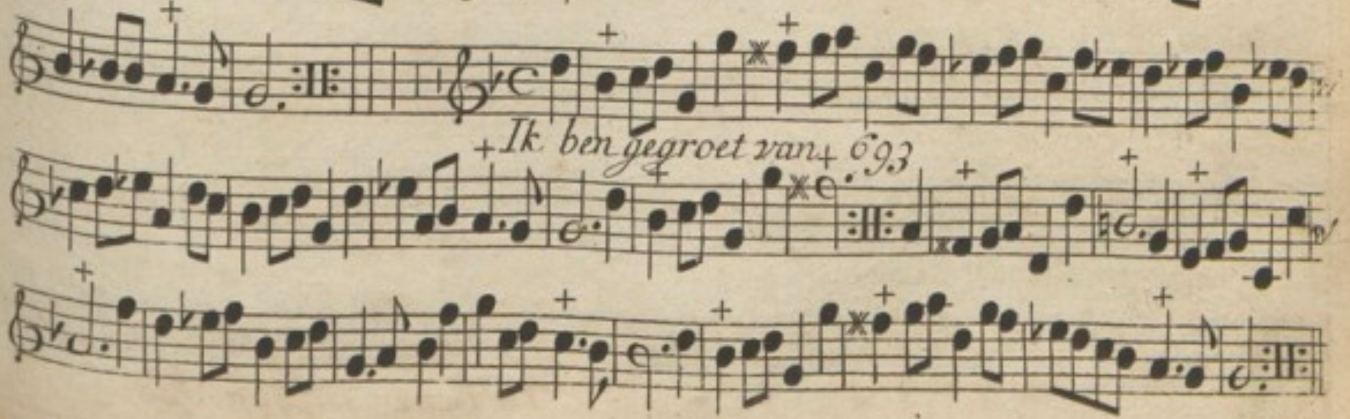
Contemporary reports suggest that the fugue subject, a distinctive, syncopated Dutch melody, “Ik ben gegroet van,” was given to Bach as an improvisational challenge. His resulting treatment transforms this folk-like tune into a contrapuntal monument. The original Ik ben gegroet van follows:
~ Intermission ~
Kristina Ziema Rizzotto
Three wedding marches for my siblings:
Şənlik (Jubilation)
Lūgšana (Prayer)
Coronation March
I had the joy of composing the wedding marches for my five younger siblings and their spouses, each thoughtfully crafted taking their personalities and attributes into consideration. They all got to hear them for the very first times as the brides walked down the aisle.
Şənlik (pronounced SHEN-lick) is the Azerbaijani word meaning jubilation, feast, celebration. My brother Augusto’s now wife Rumiyya is Azerbaijani and their wedding took place in their capital city Baku in 2025. They celebrated it in traditional national style, so I decided to study the characteristics of Azerbaijani folk and classical music to create a piece that could reflect her beautiful heritage. The mother of the bride later informed me that she thought the piece was written by a native, having captured the essence and many of the typical elements. Success!
Lūgšana (pronounced LOOG-shu-nah) means prayer in Latvian. My sister Laila Māra has lived in Latvia for about a decade, our other country of nationality besides Brazil, and she was married in Rīga to her husband Nicholas in 2022. I also arranged this piece for chamber orchestra.
I dedicated Coronation March to my dear sister Smaida Māra and her husband Daniel Massatt on their wedding day, June 20, 2020. The name “coronation” is a play on words – it was the Feast of the Immaculate Heart of Mary, queen of heaven, and, the composer couldn’t miss the opportunity for a corona pun during the summer of 2020…
Amy Summers (b. 1996)
O Lux Beata Trinitas
Amy Summers is a British composer whose work spans both sacred choral and organ music as well as film and media scoring. Her music has been recorded and performed by ensembles including the BBC Singers, the Exultate Singers, and Nottingham Cathedral Choir, where she previously served as Composer-in-Residence. Summers has also gained recognition for her work in film, receiving awards for her score to Every Morning (2022), and has collaborated on projects for cinema and documentary, including A Case for Love. Her music has been broadcast on BBC Radio 3 & 4 and is published by several major choral and sacred music publishers. She studied at the University of Nottingham and Trinity College of Music and currently also works as an assistant to film and television composer Segun Akinola.
O Lux Beata Trinitas is traditionally sung at Vespers during the liturgical season after Pentecost. The hymn’s text, “O blessed light of the Trinity and sovereign unity”, is a meditation on the mystery of the Triune God and the divine light that illumines creation. Like many early hymns of the Western Church, its melody is simple and dignified, shaped by graceful phrases that invite contemplation and reverence.
In Summers’s organ setting, the melody appears within shifting textures and luminous harmonies, sometimes clearly stated and at other moments suggested more subtly within the surrounding musical fabric. The composer’s sensitivity to atmosphere, evident both in her sacred music and in her work for film, allows the organ to create a soundscape that evokes radiance, stillness, and quiet awe.
O Trinity of blessed Light,
O Unity of sovereign might,
as now the fiery sun departs,
shed Thou Thy beams within our hearts.
To Thee our morning song of praise,
to Thee our evening prayer we raise;
Thee may our glory evermore
in lowly reverence adore.
All laud to God the Father be;
all praise, Eternal Son, to Thee;
all glory, as is ever meet,
to God the Holy Paraclete.
Johann Sebastian Bach
Prelude and Fugue in D Major, BWV 532
J. S. Bach was hired in 1709 by the ruling duke of Weimar, Wilhelm Ernst, as an organist and member of the court orchestra. He was particularly encouraged by the duke to make use of his unique talents with the organ. Indeed, his fame as an organist grew during that period, and he was visited by many students eager to hear him play and learn from his technique. He composed the Prelude and Fugue in D, BWV 532, during his tenure in Weimar, circa 1710. The Prelude consists of a brilliant and wide-ranging introduction, a contrapuntal Alla breve in Italian style with slowly shifting harmonies, and a slow section that ends with recitative-like passages in preparation for the fugue. The fugue subject shows Bach’s fascinating inventiveness in shaping something extraordinary out of repetitions and sequences (the same material at a different pitch). He was clearly fascinated by this remarkable subject because he reused it in his Toccata in D major, BWV 912, which may date from around the same time.
Kristina Ziema Rizzotto
Fantasia
Fantasia came together as a compilation of joyful melodies which kept dancing inside of my head in recent years. I wrote it as it came to me, and the result was an orchestral dance with Slavic flavors, with crisp strings, shepherd’s flutes, a pizzicato waltz with mellow cellos and a singing oboe, culminating in a triumphant gallop of the cellos and basses, when the brass and piccolo gradually join in for a final display of fireworks. Can you hear it all? Once again my Latvian roots made an unplanned appearance, this time after the waltz, as the folk song “Kur tad tu nu biji, āzīti manu?” (Where have you been, my little goat?) spontaneously found its way into this musical extravaganza when the pedal line began to dance.
All my compositions are available as PDF music scores on kristinarizzotto.com/compositions
Scan the QR code below with your phone camera to open this page on your mobile device: